Choosing the right manufacturing partner is an important decision for businesses involved in architectural lighting, commercial installations, retail displays, and decorative projects. A reliable manufacturer should offer more than competitive prices. Product quality, customization options, technical knowledge, and consistent production standards all influence the success of a lighting project. Working with an experienced LED lighting manufacturer China can help businesses access different LED strip technologies and find suitable solutions for specific installation requirements.
However, not every manufacturer offers the same level of flexibility or technical support. Before selecting a supplier, buyers should understand the available LED strip types, compare their specifications, and evaluate whether the manufacturer can support both small and large orders.
1. Evaluate the Manufacturer’s Product Range
A professional LED strip manufacturer should provide multiple product options because different projects require different lighting characteristics. For example, residential cove lighting may need soft, consistent illumination, while commercial signage may require brighter strips with specific colors and waterproof protection.
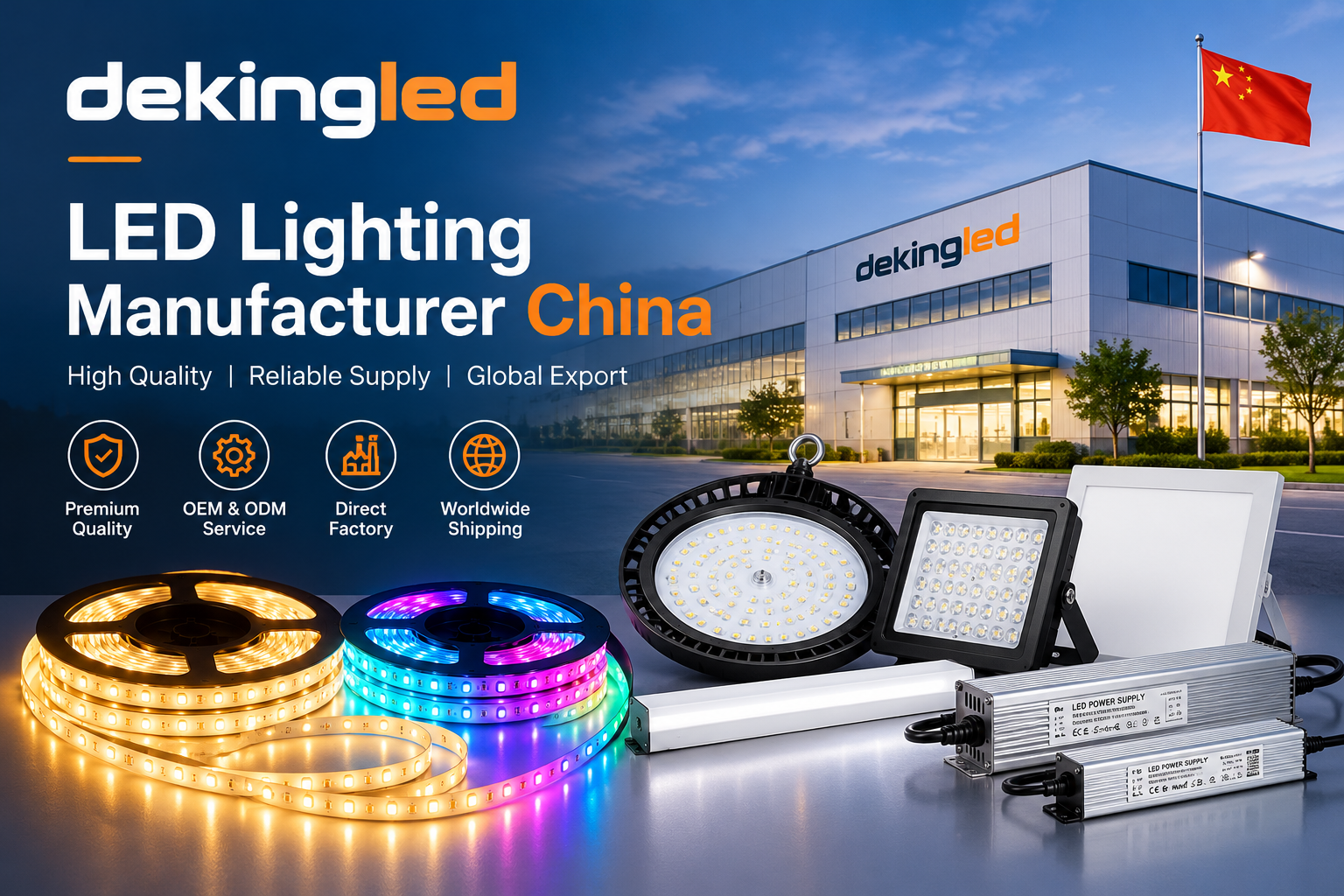
Shenzhen Dekingled Co., Ltd. offers several LED strip lighting options, including SMD3528, SMD2835, SMD3014, SMD5050, RGB, RGBW, COB, and silicone neon products. The company was established in 2014 and operates from Shenzhen, China.
Understanding these product categories helps buyers select lighting solutions based on brightness, installation environment, flexibility, and appearance.
SMD5050 LED Strips for Decorative Lighting
SMD5050 LED strips are suitable for projects that require colorful illumination and decorative effects. They can be used in homes, shopping malls, retail stores, signage, and entertainment spaces.
Dekingled’s 5050 LED strip features 300 LEDs per 5-meter reel, a maximum power rating of 17W per meter, and a 120-degree viewing angle. It is available with IP65 and IP68 protection options, depending on the product configuration.
These characteristics make the product useful for applications such as:
Architectural and cove lighting
Signage backlighting and edge lighting
Decorative lighting for events and exhibitions
Window, corridor, and canopy illumination
Pathway and contour marking
COB LED Strips for Uniform Illumination
COB technology is another option for projects where a smooth lighting appearance is important. Unlike conventional LED strips that can produce visible individual light points, COB strips are designed to provide more continuous illumination.
This makes them suitable for modern interior designs, display areas, and applications where the lighting source remains visible.
Dekingled offers free-cutting 12V and 24V COB LED strip options. Its 24V versions are designed to provide lower voltage drop over longer runs compared with 12V versions. The company also identifies IP44 dust resistance as a feature of its COB strip range.
2. Check Customization and OEM Capabilities
Customization is especially important for distributors, lighting brands, contractors, and businesses developing their own product ranges. Standard products may not always match a project’s required dimensions, color temperature, brightness, or installation conditions.
An experienced LED strip OEM manufacturer can help buyers source products that match their business requirements. Before placing an order, ask about available customization options, product configurations, packaging, and technical specifications.
Some important factors to discuss include:
LED chip type and density
Strip width and PCB configuration
Input voltage and maximum power
Cutting intervals
Waterproof protection levels
Available colors and color temperatures
Packaging and reel length
For example, Dekingled’s 5050-WW-300 strip contains 300 LEDs per 5-meter reel and supports DC12V and DC24V configurations. It also offers copper or white PCB options, 3M adhesive backing, and a maximum power rating of 72W.
These details can help buyers determine whether a particular configuration is suitable for their intended installation.
3. Compare Technical Specifications Before Ordering
Product appearance alone is not enough to determine whether an LED strip is appropriate for a project. Buyers should compare technical specifications carefully to avoid installation problems and unexpected performance differences.
The following examples demonstrate how different LED strip models can serve different requirements.
3528 LED Strip
The Dekingled 3528 LED strip uses SMD3528 chips, contains 300 LEDs per 5-meter reel, and has a maximum power consumption of 4.8W per meter. Its listed configuration includes a 5000 × 8 × 0.35mm PCB, 12V DC or 24V DC operation, and IP65 protection.
This type of strip can be considered for applications where a compact design and relatively low power consumption are important.
2835 LED Strip
For projects requiring higher LED density, the 2835 range offers another option.
Dekingled’s 2835 model with 180 LEDs per meter contains 900 LEDs across a 5-meter reel, operates at 24V DC, and has a maximum power rating of 48W. The product also features 3M adhesive backing, 3oz copper foil, and a cutting interval of nine LEDs.
3014 LED Strip
The 3014 LED strip contains 240 LEDs per meter and 1,200 LEDs per 5-meter reel. Its listed specifications include 12–14 lumens per LED, a maximum power rating of 12W per meter, 24V DC input, and a cutting interval of six LEDs.
Comparing these specifications helps buyers select the appropriate product rather than choosing solely by price.
4. Consider Waterproof Protection and Installation Conditions
The installation environment should always influence the product selection process. Indoor decorative lighting and outdoor architectural projects do not necessarily require the same level of protection.
For example, indoor installations may use products designed for dry environments, while outdoor applications require suitable protection against moisture and other environmental conditions.
Dekingled offers LED strip options with IP65 and IP68 protection. Its IP68 waterproof strip is designed to remain protected against water ingress at a depth of up to three meters.
Buyers should confirm the exact protection rating of the selected model and check whether the complete installation, including connections and accessories, is suitable for the intended environment.
5. Look for Technical Support and Reliable Delivery
Manufacturing capability is only one part of a successful supplier relationship. Communication, delivery arrangements, and technical assistance also matter, particularly for businesses handling multiple projects or recurring orders.
Before choosing a supplier, consider asking about production lead times, order quantities, packaging arrangements, product documentation, and after-sales assistance.
Shenzhen Dekingled Co., Ltd. highlights fast delivery, cost-effective products, product quality, and technical support among its service advantages. These factors can be useful when evaluating a potential long-term manufacturing relationship.
It is also sensible to request product samples before committing to a large order. Testing samples allows buyers to examine brightness, color consistency, flexibility, adhesive performance, and installation suitability.
Conclusion
Selecting the right LED strip manufacturing partner requires careful consideration of product variety, customization capabilities, technical specifications, waterproof protection, and customer support. Different projects have different lighting requirements, so buyers should compare available models instead of relying on price alone.
From SMD3528 and SMD2835 strips to SMD5050, RGBW, COB, and silicone neon lighting, Dekingled offers several product categories for residential, commercial, architectural, and decorative applications. By reviewing specifications, testing samples, and discussing project requirements in advance, businesses can make more informed purchasing decisions and establish a dependable manufacturing relationship.