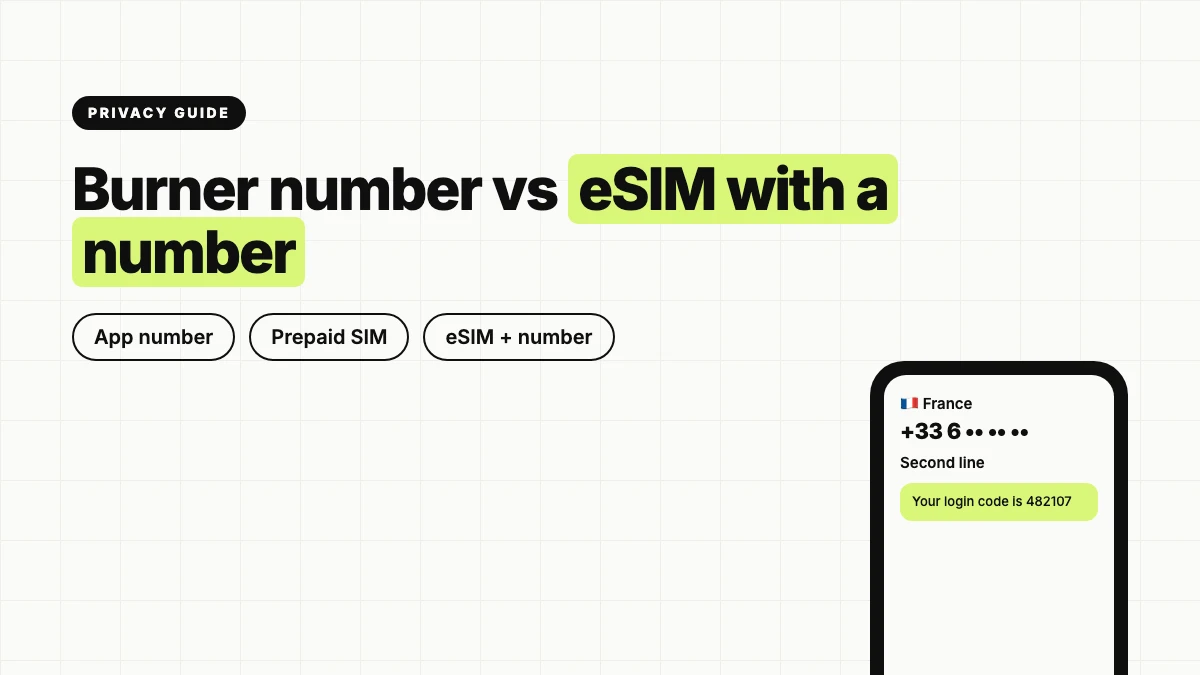
In crime shows, a burner is a cheap handset used for a few calls and then thrown away. In everyday life it means almost any spare number you give out instead of your real one: to a stranger buying your old sofa, to a first date, to a sign-up form that insists on a number.
Three quite different things get sold under that label: a number that lives inside an app, a prepaid SIM card from a shop, and an eSIM that comes with its own number. They protect different things. The first question is who you are keeping your number from.
Start with who you are hiding from
There are two audiences. The first is people: the buyer or the date who might save your number, search for it online, or keep messaging after you have stopped replying. The second is systems: the mobile network, the companies whose apps you use, and anyone with access to their records.
Almost any second number deals with the first group. No number on its own deals with the second, for reasons that come down to the phone itself rather than the SIM inside it.
Burner apps: a number that lives in an app
Burner and Hushed are the names most people know, alongside Google Voice and TextNow. All of them give you VoIP numbers. VoIP stands for Voice over Internet Protocol, which simply means your calls and texts travel over the internet as app data rather than over the mobile network.
Against people, they work well. The buyer sees a number that isn’t yours, and once the sale is done you can drop it.
Against systems, they struggle. Many websites and apps run a line-type lookup, a quick automated check that reports whether a number is mobile, landline or VoIP. Fraud teams tend to block VoIP numbers because they are cheap, easy to throw away and rented out in bulk, and banks and some apps often turn away Google Voice and TextNow numbers in particular. Google Voice also needs a Google account and a check against an existing US non-VoIP number, so it is tied to your real details from the first day.
Free “receive SMS online” websites and cheap one-time verification services are worse: shared mailboxes, not privacy tools. On a public receive-SMS page, anyone watching the same page can request a login code for an account registered there and take it over. Cheap verification services run on recycled pools of numbers: after your login, the number goes back into the pool, and whoever gets it next can receive your codes.
Prepaid burner SIMs: the classic version
This is the option closest to the crime-show original: a prepaid, or pay-as-you-go, SIM card bought off the shelf. It gives you a real mobile number, so a line-type lookup reports it as mobile rather than VoIP.
Whether you need ID to buy one depends on where you are. The US and the UK have no SIM registration law for prepaid SIMs. Many other countries, Spain and Germany for example, require ID for any SIM, and where registration is mandatory, using an unregistered SIM can itself be an offense.
The bigger limit is physical. Every phone has a hardware serial number called an IMEI, short for International Mobile Equipment Identity, and sends it to the network. Put a burner SIM into your everyday phone and the network sees the same handset that carries your main line. The SIM may not have your name on it, but the phone it sits in is the one you have carried for years. On a single-slot phone, your main SIM also ends up in a drawer while the burner is in.
eSIM with a number: the newer middle option
An eSIM is a SIM downloaded into the phone as a digital profile instead of a plastic card. Most recent phones support dual SIM, either a physical SIM plus an eSIM or two eSIMs, so a second line can run next to your main one.
Not every eSIM has a number. A data-only eSIM gets you online, but nobody can call it or text it. Some providers sell eSIMs that do include one. Cypher eSIM is one example: its eSIM puts calls in both directions, SMS and mobile data on one eSIM, with no account, no email and no ID at checkout. The number runs on a mobile network rather than inside an app, so it is not a VoIP number. Its country is shown on the plan card before payment; European plans carry a French +33 number, and some destinations have local numbers.
Plans are time-boxed, so the number lasts as long as the plan. That is the idea behind a burner eSIM: a mobile number for a trip or a project, with nothing about you attached at purchase.
Be precise about what that buys you. Buying without ID hides who bought the line. It does not hide what the phone does. Installed on your everyday phone, both lines report the same IMEI to the network, from the same places, at the same times. And no provider can promise that a specific bank or app will accept it.
When a separate phone is worth it
Real separation at the network level needs separate hardware. A new SIM or eSIM on your main phone does not detach the second line from your device. Against a nosy buyer or a date, that hardly matters, since they never see your IMEI. If the worry is that the two lines could be linked in network records, the second line needs a handset that never holds your main SIM.
Even then, habits undo hardware. Signing into your usual email or social accounts on the second phone ties the two together, and so does carrying both phones everywhere or ringing your regular contacts from the second line.
A rough guide:
- Selling something online or answering a listing: a burner app is usually enough, if the site accepts it.
- Signing up for a service that rejects VoIP: a prepaid SIM or an eSIM with a number, since both show up as mobile.
- A second line for a project or a trip, without your name attached at purchase: an eSIM with a number, accepting that it ends with the plan.
- Keeping the second line apart from your main phone in network records: separate hardware, and separate habits.
- Codes for accounts you will need for years: your main number, not any burner.
That last point catches people out. Anything registered to a temporary or recycled number can be hard to recover once the number is gone.
FAQ
Is a burner number anonymous? No. It keeps your main number away from the people you give it to, and a purchase with no ID hides who bought the line. It does not hide your phone’s IMEI, where the phone is used, or the accounts you sign into on it.
Can I buy a prepaid SIM without showing ID? In the US and the UK, yes, since neither has a SIM registration law for prepaid SIMs. Many other countries, including Spain and Germany, require ID for any SIM.
Why did an app reject my burner number? Most likely a line-type lookup flagged it as VoIP, a type of number fraud teams often block. A mobile-network number avoids that particular flag, but no provider can guarantee that a specific app will accept a specific number.