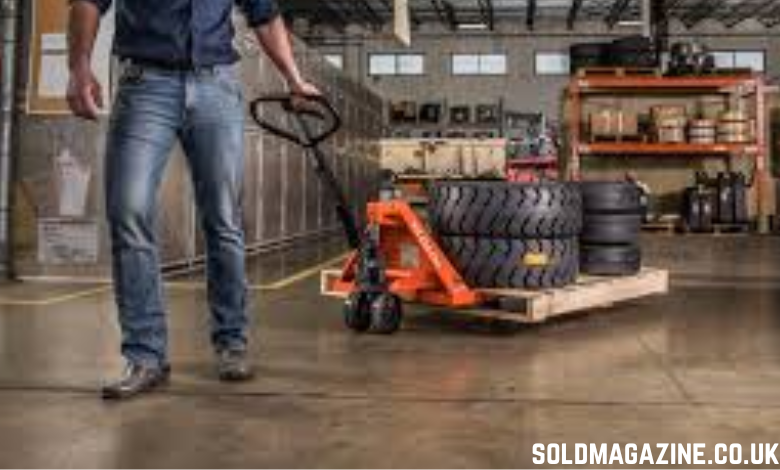
If your team is dragging goods by hand or waiting on the only available forklift, you’re bleeding minutes (and margins). A hand pallet truck is the low-cost, high-impact fix that keeps stock moving, protects your team, and smooths out the daily peaks without tying up capital.
TL;DR (for busy ops leads)
- Cheap to run, fast to deploy — perfect for peaks and gaps.
- No licence required — quick in-house briefing and go.
- Cuts manual handling risk — fewer strains and stoppages.
- Compact & reliable — store anywhere, works all day.
- Hire = flexibility — scale up or swap models as needs change.
1) The Use Case: Smoothing Out the Real Bottlenecks
Warehouses don’t fail on big plans; they fail on micro delays — a pallet that can’t move, a picker waiting, a forklift tied up on another aisle. A hand pallet truck hire keeps short-haul moves flowing: inbound to marshalling, pick-face replenishment, dispatch staging, pop-up inventory counts, and reconfigurations.
Where it shines
- Day-to-day pick-face top-ups
- Short hops between racks, staging and goods-out
- Seasonal spikes (Black Friday, January returns, range resets)
- New layout pilots and stock counts
2) Cost That Makes Sense
Buying ties up cash and commits you to maintenance. Hiring a pallet truck:
- Avoids upfront spend and depreciation
- Gives predictable weekly rates
- Lets you flex fleet size with demand
- Swaps out units quickly if something fails
Result: the tool you need now, without board approval or a 5-year plan.
3) Quick to Learn, No Licence Needed
Unlike powered kit, a manual pallet truck doesn’t need a driving licence or formal certification. With a short induction and a sensible SOP, temps and new starters can be productive the same shift.
Good practice: keep a one-page guide posted at goods-in: safe push technique, gradient limits, and a “three strikes” policy for damaged pallets.
4) Reduce Manual Handling Risk
The number-one cause of lost warehouse hours? Back and shoulder strains. A pallet truck:
- Removes the bulk of lifting and carrying
- Moves heavy loads smoothly over short distances
- Helps standardise safe handling — less improvisation, fewer incidents
Add floor markings and clear lanes, and you’ll see fewer near-misses and cleaner traffic flow.
5) Small, Tough, and Low-Fuss
- Capacity: commonly up to 2,500 kg (check model).
- Footprint: tucks under benches, parks in narrow gaps.
- Maintenance: minimal — wheels and hydraulics checked on schedule.
- Variants: extra-long forks, low-profile, galvanised/stainless (food/chem), high-lift, and weigh-scale versions.
Hiring from a reputable supplier means pre-checked hydraulics, straight forks, smooth rollers, and replacements on standby.
6) When to Step Up from Manual
A hand pallet truck is brilliant until it isn’t. Consider powered options if you have:
- Long travel distances across large sheds
- Ramps/gradients or rougher surfaces
- Strict time windows with high-throughput targets
- Heavy daily cycles where fatigue becomes a risk
A blended fleet — a few powered pallet trucks plus hired manuals — often hits the sweet spot.
7) What’s Included in the Hire (and What to Confirm)
Avoid surprises — confirm:
- Delivery/collection windows (and any off-hours charges)
- Model/capacity, fork length/width, and turning radius
- Roller/wheel material (poly, nylon, rubber) matched to your floor
- Service cover and like-for-like swap if anything fails
- Optional weigh-scale or low-profile versions if needed
Quick SOP / Toolbox Card (copy for your noticeboard)
Before use
□ Check forks are straight, rollers spin freely, hydraulics raise/hold
□ Inspect pallet for broken boards or protruding nails
□ Plan route: no ramps, spills, or congested aisles
During use
□ Push, don’t pull (unless positioning precisely)
□ Keep load centred and low; watch toes and corners
□ Maintain clear sightline; use a spotter in blind spots
After use
□ Park out of walkways, forks lowered
□ Report damage; tag out if not safe
□ Keep charge/maintenance notes up to date (if using weigh-scale units)
FAQs (snippet-friendly)
Do I need training?
No formal licence, but give staff a brief induction and a written SOP.
What’s the max load?
Most standard units carry up to 2,500 kg. Always check the rating plate and your pallet condition.
Can I use them on ramps?
They’re designed for flat, smooth floors. For ramps or uneven surfaces, move to powered options.
How long can I hire for?
From daily to long-term agreements. Many sites keep a base quantity on long-term hire and flex up for peaks.
Will the wheels damage floors?
Choose the right roller material for your surface (poly/nylon/rubber). Your supplier can advise.
Why Teams Hire (Not Buy)
- Flex your fleet with the season
- No downtime risk — swap if a unit fails
- Cleaner balance sheet vs capital purchase
- Rapid onboarding — temps productive on day one
Ready to keep goods moving?
Share your load weights, floor type, aisle widths, and peak schedule. We’ll match the right fork length, capacity, and wheel material, deliver fast, and keep you covered if anything needs swapping.
Meta (for CMS)
- Primary keyword: hand pallet truck
- Secondary keywords: pallet truck hire, warehouse operations, manual handling, warehouse efficiency
- Search intent: operational decision & pre-hire guidance
- Optimised for: AEO/GEO/SEO (clear headings, TL;DR, FAQs, checklist)
- Region & spelling: UK / British English