Introduction
Urban infrastructure is evolving rapidly as cities strive to adopt more sustainable, efficient, and cost-effective solutions. One of the persistent challenges affecting street lighting systems worldwide is dust accumulation. This issue not only reduces the efficiency of street lamps but also leads to higher maintenance costs, decreased lifespan, and lower overall lighting performance. As the demand for cleaner and smarter cities grows, the question arises: does self-cleaning street lamp research exist, and can dust-resistant lamp technologies provide a solution?
The Problem: Dust and Street Lighting
Street lamps are continuously exposed to the elements, including dust, pollution, and grime. In urban, industrial, and desert regions, dust accumulation on lamps happens quickly and significantly affects their performance.
Key Challenges Caused by Dust:
Reduced Illumination Efficiency: Dust accumulation on street lamps can reduce their light output by up to 40%. As dust and grime build up on the lamp’s surface, the light emitted is less effective, making streets poorly lit and unsafe for pedestrians and vehicles.
Solar Panel Efficiency Loss: For solar-powered street lamps, dust poses an even more significant challenge. Dust particles block sunlight from reaching the photovoltaic cells, which can reduce solar energy generation by up to 30%. Over time, this leads to shorter operating hours, and in some cases, the lamps may stop functioning altogether.
Increased Maintenance Costs: Manual cleaning of street lamps is costly and time-consuming. It involves labor, specialized equipment, water, and safety precautions. Moreover, the cleaning process is often not effective enough to maintain the desired light output.
Shortened Lifespan of Lamps: Dust not only affects light quality but can also damage the internal components of the lamps. Heat buildup caused by dust can shorten the lifespan of LEDs and other critical electronics.
Safety Risks: Insufficient lighting due to dust accumulation can result in unsafe conditions, particularly on roads. Reduced visibility makes streets more hazardous, leading to an increased risk of accidents.
The Solution: Self-Cleaning Street Lamps
To tackle these issues, the development of self-cleaning street lamps has emerged as a promising solution. Self-cleaning street lamps are designed to automatically repel, prevent, or remove dust and dirt from critical surfaces, such as the lamp’s glass cover or solar panels. These technologies aim to reduce manual cleaning, lower maintenance costs, and ensure consistent performance in harsh environments.
Self-cleaning lamps are not simply a futuristic concept—they are already being researched and deployed in real-world settings. Researchers, governments, and private companies are exploring several technologies to make street lighting more efficient and less reliant on manual labor.
Technologies Powering Self-Cleaning Street Lamps
The self-cleaning and dust-resistant technologies for street lamps vary widely, but they all aim to address the issue of dust accumulation in a sustainable, cost-effective way.
1. Hydrophobic Coatings (Lotus Leaf Effect)
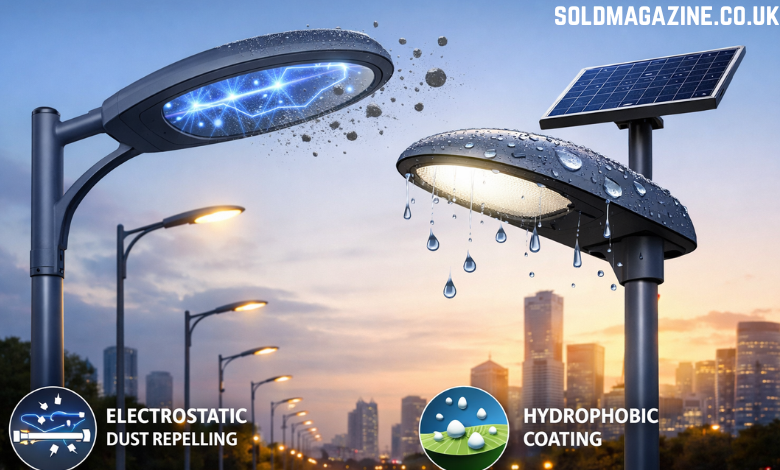
One of the most promising approaches involves hydrophobic coatings that reduce the adhesion of dust and dirt. Inspired by the lotus leaf, which repels water and dust, these coatings are applied to the glass surfaces of street lamps. The coatings make it more difficult for dust to stick, allowing wind, rain, or the motion of the lamp itself to remove the particles over time.
This technology doesn’t eliminate dust entirely, but it does slow the buildup and reduces the frequency of required cleaning. The key benefit is that it decreases maintenance efforts while still maintaining the lamp’s illumination efficiency.
2. Electrostatic Dust Repulsion
Another effective technology for self-cleaning lamps involves the use of electrostatic fields to push dust particles off the surface. Transparent electrodes embedded in the lamp’s surface generate an electric field that charges the dust particles. As the particles are electrically charged, they are repelled and pushed away from the lamp’s surface. This technology is highly energy-efficient, using very little power to keep the lamps clean.
The beauty of this system lies in its ability to work without water, which is especially beneficial in areas where water resources are scarce. It also helps maintain the street lamps’ solar efficiency by preventing dust buildup on solar panels.
3. Automated Cleaning Systems
For more advanced self-cleaning street lamps, automated cleaning systems can be integrated. These systems use smart sensors and actuators to monitor dust accumulation levels and automatically initiate cleaning processes. These systems can use mechanical brushes or a combination of electrostatic repulsion and vibration to remove dust.
These smart street lamps are often connected to cloud-based platforms that allow for remote monitoring and maintenance scheduling. This technology allows municipalities to optimize street lighting systems, ensuring that they remain operational without requiring constant manual intervention.
Real-World Applications of Self-Cleaning Street Lamps
Research and development in the field of self-cleaning street lamps are ongoing, with several cities and countries already testing various technologies in real-world environments.
For instance, in desert regions like the Middle East, where dust accumulation is a major issue, cities are experimenting with self-cleaning solar-powered street lamps. These lamps incorporate both hydrophobic coatings and electrostatic repulsion technologies to keep solar panels free from dust, ensuring efficient energy generation even in harsh conditions.
In Europe, some cities are testing smart street lamps that use IoT sensors to monitor dust accumulation. These lamps can automatically activate self-cleaning mechanisms when needed, ensuring consistent light quality and reducing maintenance costs.
These pilot projects have shown promising results, with self-cleaning lamps proving to be effective in reducing maintenance needs and ensuring a higher level of performance than traditional street lamps.
The Future of Self-Cleaning Street Lamps
The future of self-cleaning street lamps looks bright. As research continues and technology improves, self-cleaning lamps are expected to become more common in cities worldwide. Several factors are driving this shift:
Decreasing Costs of Technology: As the cost of smart sensors, solar panels, and electronic components continues to drop, self-cleaning street lamps will become more affordable for cities to deploy.
Environmental Sustainability: With an increasing focus on sustainability, self-cleaning lamps offer a way to reduce water consumption and minimize the carbon footprint associated with manual cleaning.
Smart City Investments: Cities are increasingly investing in smart infrastructure, and self-cleaning street lamps fit well within the broader goals of smart city development. These technologies not only improve efficiency but also contribute to the broader aim of making cities more sustainable and technologically advanced.
Improved Material Science: As materials science continues to advance, new coatings and dust-repelling technologies will make self-cleaning street lamps even more effective and durable, particularly in extreme environments like deserts or industrial zones.
Conclusion
Self-cleaning street lamps are no longer just a concept—they are an emerging reality that has the potential to transform urban lighting systems. By addressing the issues caused by dust accumulation, these lamps offer a sustainable and cost-effective solution that reduces maintenance needs and improves lighting efficiency. Although the widespread deployment of self-cleaning street lamps is still in its early stages, ongoing research, technological advancements, and smart city initiatives suggest that these systems will play a critical role in the future of urban infrastructure. As cities continue to evolve and adopt cleaner, smarter solutions, self-cleaning street lamps will help ensure safer, more efficient, and sustainable urban environments for all.
FAQS
What are self-cleaning street lamps?
Self-cleaning street lamps use innovative technologies to repel or remove dust, reducing maintenance and improving lamp efficiency.
How do dust-resistant lamps work?
These lamps use hydrophobic coatings or electric fields to prevent dust buildup, keeping the surfaces clean without manual cleaning.
Are self-cleaning street lamps effective in desert areas?
Yes, self-cleaning technologies are particularly effective in desert regions where dust accumulation on lamps is a significant problem.
Do self-cleaning lamps reduce maintenance costs?
Yes, self-cleaning lamps help reduce maintenance costs by minimizing the need for manual cleaning and improving energy efficiency.
Are self-cleaning street lamps widely deployed?
While still in experimental phases, several cities have begun testing self-cleaning street lamps with promising results, and adoption is increasing.